
Methodology
How PFD Monitor works
PFD Monitor uses AI to analyse Prevention of Future Deaths reports and the official responses to them. It brings together concerns raised by coroners, responses from organisations, and actions those organisations say they plan, are carrying out, or have completed.
This makes it easier to find concerns that have appeared in more than one report and to explore the published record over time.
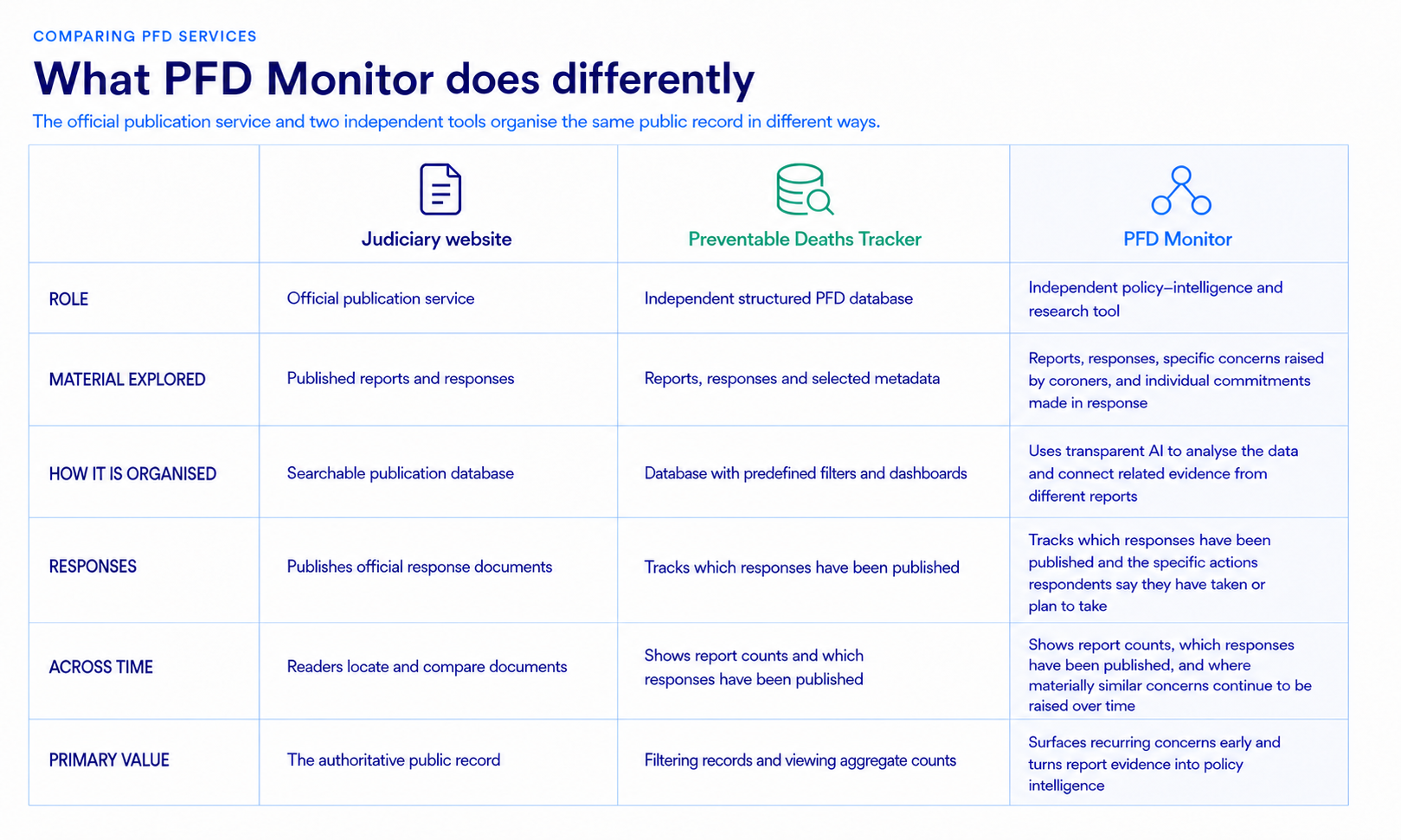
What PFD Monitor does
You can use PFD Monitor to:
- find reports that raise similar concerns;
- see which organisations received them;
- read the organisations' published responses; and
- explore the actions they say they planned, started, or completed.
From documents to evidence
1. We collect official reports and responses
PFD Monitor collects Prevention of Future Deaths reports and official responses from public sources. We record where and when each document was found and check for changes when the collection is updated.
2. AI records what each document says
PFD Monitor extracts each individual concern a coroner raised within their report. It also records who received the report and what each responding organisation said.
The coroner's or respondent's original words are kept with a link to the source. PFD Monitor may add a shorter description to make the information easier to search and compare, but that description never replaces the original wording.
Quality check
Each concern, response, or action must point back to supporting text in the source document. If that link cannot be made reliably, the record can be held back for further checks.
3. AI looks for concerns that have appeared before
PFD Monitor compares each concern with concerns in other reports. When concerns describe the same underlying safety problem, they can be brought together as a recurring issue.
Similar wording is not enough on its own. The AI checks whether grouping the concerns hides an important difference. If a concern is unique or unclear, or does not match closely enough, it remains available on its own report page.
4. We check and publish the results
Automated checks make sure that the expected evidence is present and that links between records are valid. Some cases may also be sent for human review, such as unclear sources, possible new recurring issues, or corrections raised by readers. A person does not routinely check every AI decision.
PFD Monitor publishes each completed release as a fixed, versioned set of records. This means later corrections and changes can be traced rather than silently replacing what was published before.
Technical note
The process combines AI analysis with rule-based checks and publication controls. We explain what the AI does, the evidence it uses, and the limits of its findings. Exact prompts, thresholds, software, and testing materials are proprietary.
How to interpret the findings
PFD Monitor can show that reports contain similar concerns, that an organisation received a report, and that an official response describes a planned, ongoing, or completed action.
It cannot show on this evidence alone that an organisation caused a problem, ignored a warning, or failed to act. Nor can it prove that a stated action was carried out or worked, that two deaths had the same cause, or that an organisation met or failed to meet a legal duty.
Interpret with care
PFD Monitor highlights patterns worth investigating. Its connections are a way into the evidence, not conclusions about responsibility, causation, or organisational performance.
Read more
- Sources and coverage
- From documents to evidence
- How concerns become recurring issues
- How responses and stated actions are handled
- Quality assurance and revisions
- Limitations and responsible use
Corrections and feedback
If a PFD Monitor record appears to misrepresent its source, readers can send us the page address, the relevant passage, and an explanation of the problem. Important corrections and changes to the method appear in the change log.